Autologous cytokine-rich serum (ACRS) stimulates and accelerates the repair of both soft and hard tissues.
—oOo—
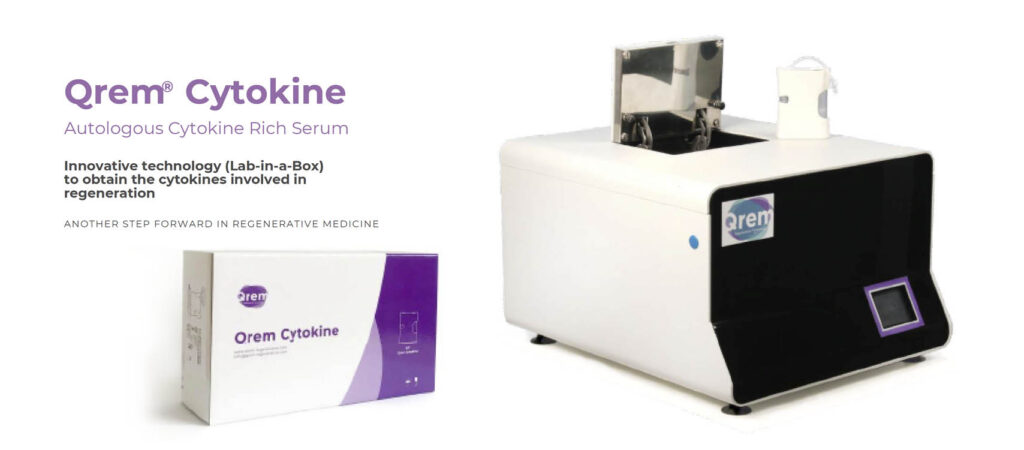
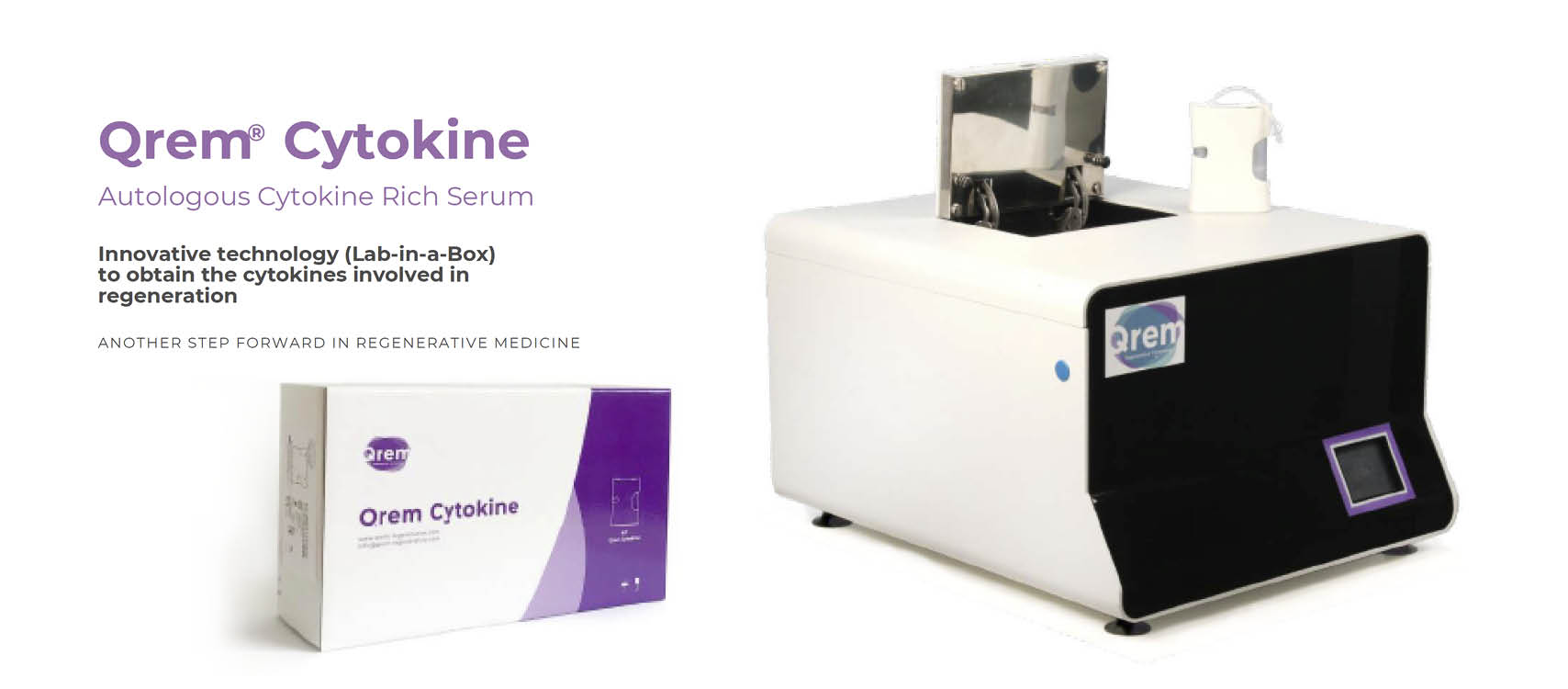
QREM Lab-in-a-Box Cytokine ACRS solution accelerates the manufacturing process in a patented Lab-in-a-Box setup, creating a cell-free serum with a balanced concentration of cytokines from plasma, white blood cells and platelets in just 36 minutes.

Free of drugs
ACRS does not contain drugs; it does not have side effects, as may occur with other treatments that only reduce pain temporarily.

How does Qrem Cytokine work?
Qrem Cytokine is an innovative technology for obtaining cytokines involved in tissue regeneration. From a patient’s blood, autologous cytokine-rich serum (ACRS) is obtained using a patented biological process that emulates ex vivo tissue damage.
Closed Sterile System
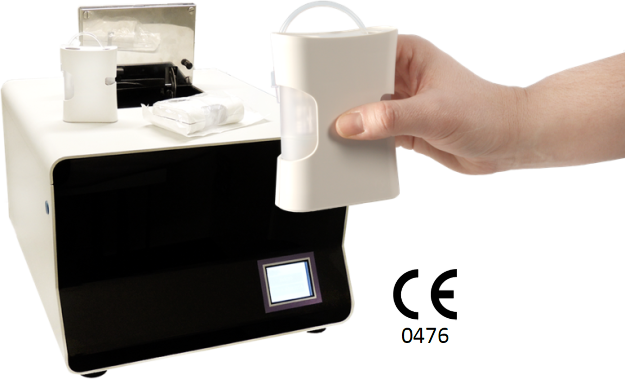
It is a closed and automatic technique consisting of a device (QREM DEVICE) and a single-use sterile disposable kit (KIT QREM CYTOKINE). It can be installed in any-sized doctor’s office without special infrastructure or specifically trained personnel. Medical professionals can offer these therapies in their consulting rooms easily and affordably, thus meeting some patients’ unmet needs.
Qrem Cytokine technology is composed of a few simple steps
 Blood is drawn from the patient
 Kits Qrem is filled with the patients blood
 The Qrem kit is placed into the Qrem device
 Automatic Cytokine colllection process is started
 After 36 minutes, ACRS is ready to be injected
Frequently Asked Questions
Qrem Cytokine is an innovative technology for obtaining cytokines involved in tissue regeneration. Based on the patient’s own blood, autologous cytokine rich serum (ACRS) is obtained through a patented biological process that emulates ex vivo tissue damage.
This product has the CE marking MDR00040 granted by Notified Body KIWA Cermet (nº 0476).
It is a closed and automatic lab-in-a-box technology consisting of a device (QREM DEVICE) and a single-use, disposable, sterile kit (KIT QREM CYTOKINE). It can be installed in any doctor’s office, no matter how small. No specific training or special facility infrastructure is required.
The QREM DEVICE and the KIT QREM CYTOKINE are medical devices class IIa that have been commercialised in Europe since 2018.

The main difference is that leukocytes are used during the ACRS process, which allows the obtaining of anti-inflammatory cytokines.
ACRS does not contain platelets, fibrinogen, or other types of blood cells. Still, it directly contains the anti-inflammatory and anabolic cytokines (also known as growth factors) involved in tissue regeneration. While PRP contains mainly the mediator (platelets), ACRS directly includes the active ingredient (cytokines); and, while PRP must be activated for the growth factors it contains to be released (either with calcium chloride or endogenously), ACRS is obtained through a natural process without additives or incubation that replicates endogenous signaling pathways.

Qrem Cytokine technology carries out a multi-step process that takes 36 minutes. This process emulates ex vivo tissue damage that produces the blood cells to be activated and to release the regeneration-modulating cytokines contained in ACRS.
To obtain the ACRS, the KIT QREM CYTOKINE is subjected to a cycle of 8 processing steps segmented into 3 phases, each lasting 36 minutes. The first phase corresponds to cell fractionation, the second to the activation of platelets and white blood cells, and the third to the release of cytokines and growth factors. The QREM DEVICE performs all steps automatically.
According to Annex VIII of Regulation (EU) 2017/745, QREM DEVICE and KIT QREM CYTOKINE are non-implantable Class IIa medical devices and are indicated for obtention of autologous platelet by-products used in all musculoskeletal or dermatological clinical specialty treatments that require the injection of platelet derivatives, such as growth factors, cytokines, and biological mediators to achieve the stimulation and healing acceleration of both soft tissue and hard tissue (including bone).
According to Annex VIII of Regulation (EU) 2017/745, QREM DEVICE and KIT QREM CYTOKINE are non-implantable Class IIa medical devices and are indicated for obtention of autologous platelet by-products used in all musculoskeletal or dermatological clinical specialty treatments that require the injection of platelet derivatives, such as growth factors, cytokines, and biological mediators to achieve the stimulation and healing acceleration of both soft tissue and hard tissue (including bone).
Cytokines & Regenerative Medicine
Osteoarthritis (OA) is the most common form of arthritis. It is a degenerative and chronic disorder associated with damage to the cartilage and surrounding tissues. Characterized by damage and loss of cartilage, OA causes friction between bones, which causes huge pain and disability.
Joints of the knees, hips, back (spine), fingers, thumbs and neck are commonly affected.
The conventional therapies used in the initial phases are analgesics, anti-inflammatories, and chondroprotectives. When pain and dysfunction increase, injections of corticosteroids, hyaluronic acid, and/or PRP (platelet-rich plasma) are prescribed. These treatments may have limitations in the doses that can be delivered, and ultimately, a prosthesis is implanted.
Worldwide, 9,6% of men and 18% of women aged>60 suffer from OA.
| OA is characterised by an imbalance of cytokines that produce cartilage degradation (pro-inflammatory cytokines) and cytokines that try to heal it (anti-inflammatory and growth factors).
Cartilage degradation is produced by inflammatory activation carried out by some cytokines, such as IL-1β, IL-6, IL-2, IL-8, and TNF, among others. Healing is carried out by cytokines IGF-1, BMP, PDGF-BB, TGF-β, IL-4, IL-10, and IL-13. |
Regenerative medicine is the name for the therapies applied to tissue regeneration and organism structure improvement.
The goal of regenerative medicine is to repair damaged tissues using cells, proteins, and/or biomaterials, addressing the disease’s root cause directly, not only symptoms.
Regenerative therapies based on stem cells have proven very promising in the treatment of degenerative diseases related to age. However, more studies are required to widen the field of clinical effectiveness.
Recently, a step forward has been taken in using immune system modulating elements, like cytokines or exosomes. These elements support existing regenerative strategies, such as mesenchyme cells of bone marrow or adipose tissue, and in some cases, they can substitute for them.
Regenerative therapies will be the next medicine revolution.
Cytokines are proteins released by blood cells and platelets. These proteins are messages used by cells to manage different processes.
Several families of cytokines exist, including proinflammatory cytokines, which promote inflammation; anti-inflammatory cytokines, which have the opposite effect; and growth factors*, which stimulate cell proliferation.
Our body works properly when pro-inflammatory, anti-inflammatory and growth factors are balanced, in other words, when homeostasis exists. Even though inflammation is a necessary process of regeneration, this state cannot be prolonged for an extended period since tissues can be damaged permanently, and this would cause cartilage degradation.
| *Growth factors: These are a type of cytokine mainly related to cell proliferation and growth. They are mainly stored in blood platelets. |
Regenerative medicine treatments can be divided into two different groups:
- Mesenchymal stem cells* treatments obtained from bone marrow or adipose tissue. This kind of treatment requires surgery and anaesthesia.
| *Mesenchymal stem cells are multipotential cells that can be differentiated (with appropriate signals) into different cell types, such as skeletal tissues, cartilage, bones, or fat. |
- Treatments with non-substitute products obtained from the patient’s venous blood. These kinds of treatments are outpatient. To get the product, the medical centre must have closed devices; if they are opened, the appropriate equipment must be used to avoid contamination. In this category, the following treatments can be found.
-
- Platelet-Rich Plasma and/or growth factors*(PRP)
- Platelet-Rich Fibrin (PRF)
- Autologous* Conditioned Serum (ACS).
- Autologous Protein Solution (APS).
- Autologous Cytokine Rich Serum (ACRS) obtained by KIT QREM CYTOKINE and QREM DEVICE.
PRP, PRF, ACS, APS, and ACRS are not cell therapies or treatments or advanced medicine therapies. However, they must always be administered under medical prescription and guarantee some quality requirements of production.
| *Growth factors: These are a type of cytokine mainly related to cell proliferation and growth. They are mainly stored in blood platelets.
*Autologous: from the patient |
PRP is the acronym for Platelet-Rich Plasma. It is a blood-derived product obtained through blood centrifugation, and it contains a high concentration of platelets (between 4 and 6 times normal values). When platelets are activated, they release growth factors that stimulate tissue regeneration.
Platelets can be activated naturally if they come into contact with the body’s activation triggers, or artificially by adding calcium chloride before infiltration. The latter is the most common activation method.
ACS is the acronym for Autologous Conditioned Serum. It is a blood-derived product obtained by incubating blood for 6 hours or more at 37ºC. During this incubation, anti-inflammatory cytokines from leukocytes are released.
APS is the acronym for Autologous Protein Solution. APS contains a high concentration of leukocytes and platelets. The process does not include incubation but requires blood processing with an open system. Part of the leukocytes and platelets are activated during this process, releasing anti-inflammatory cytokines and growth factors. The rest can be activated after injection when contacting coagulation factors produced by the body.
ACRS is the acronym for Autologous Cytokine Rich Serum. It is a cell-free serum with a balanced concentration of cytokines from plasma, leukocytes and platelets. The ACRS directly contains the active ingredient, cytokines and growth factors. The ACRS is obtained using the KIT QREM CYTOKINE and the QREM DEVICE (with Lab-in-a-box* technology). It is indicated for all treatments in musculoskeletal or dermatological clinical specialities that require platelet byproducts, such as growth factors, cytokines and biological mediators to achieve the stimulation and acceleration of the repair of both soft and hard tissues (including bone). Autologous platelet byproducts can be used for the treatment of:
- Osteoarthritis
- Tendinopathy (lateral epicondylitis, carpal tunnel syndrome, rotator cuff tears, plantar fasciitis, Achilles tendinopathy, and patellar tendinopathy)
- Musculoskeletal soft tissue injuries
- Healing of bone fractures
- Chronic low back pain
- Correction of hypertrophic and atrophic scars
- Chronic wounds that do not heal.
| *Lab-in-a-box: Automatic technology, closed and sterile, which enables it to be used as an outpatient treatment with no risk. QREM CYTOKINE system for obtaining ARCS is a Lab-in-a-box system. |
Blood-derived concentrates
PRP is the acronym for Platelet-Rich Plasma. It is a blood-derived product obtained through blood centrifugation, and it contains a high concentration of platelets (between 4 and 6 times normal values). When platelets are activated, they release growth factors that stimulate tissue regeneration.
Platelets can be activated naturally if they come into contact with the body’s activation triggers, or artificially by adding calcium chloride before infiltration. The latter is the most common activation method.
ACS is the acronym for Autologous Conditioned Serum. It is a blood-derived product obtained by incubating blood for 6 hours or more at 37ºC. During this incubation, anti-inflammatory cytokines from leukocytes are released.
APS is the acronym for Autologous Protein Solution. APS contains a high concentration of leukocytes and platelets. The process does not include incubation but requires blood processing with an open system. Part of the leukocytes and platelets are activated during this process, releasing anti-inflammatory cytokines and growth factors. The rest can be activated after injection when contacting coagulation factors produced by the body.
ACRS is the acronym for Autologous Cytokine Rich Serum. It is a cell-free serum with a balanced concentration of cytokines from plasma, leukocytes and platelets. The ACRS directly contains the active ingredient, cytokines and growth factors. The ACRS is obtained using the KIT QREM CYTOKINE and the QREM DEVICE (with Lab-in-a-box* technology). It is indicated for all treatments in musculoskeletal or dermatological clinical specialities that require platelet byproducts, such as growth factors, cytokines and biological mediators to achieve the stimulation and acceleration of the repair of both soft and hard tissues (including bone). Autologous platelet byproducts can be used for the treatment of:
- Osteoarthritis
- Tendinopathy (lateral epicondylitis, carpal tunnel syndrome, rotator cuff tears, plantar fasciitis, Achilles tendinopathy, and patellar tendinopathy)
- Musculoskeletal soft tissue injuries
- Healing of bone fractures
- Chronic low back pain
- Correction of hypertrophic and atrophic scars
- Chronic wounds that do not heal.
| *Lab-in-a-box: Automatic technology, closed and sterile, which enables it to be used as an outpatient treatment with no risk. QREM CYTOKINE system for obtaining ARCS is a Lab-in-a-box system. |
Get more information
Contact us for more information about the QREM system, pricing and how to get started.
We offer a trial period – reach out and learn more.
Call +45 31311925 or write info@puremed.dk